 SolarSavings
Uttar Pradesh offers one of the most lucrative solar programs in India. Homeowners under UPPCL can stack both central and state subsidies to secure up to ₹93,000 in total financial assistance.
Under the UP Solar Policy, the state government provides an additional flat cash incentive for residential rooftop solar installations. This extra subsidy, coupled with UPPCL's progressive net metering rules and UPNEDA's fast-track approvals, makes UP an ideal region for solar adoption. This guide details how the stacked subsidy calculation works, outlines UPNEDA's registration requirements, and provides estimated out-of-pocket costs for homes in Lucknow, Noida, Ghaziabad, and Kanpur.
💚 The UP Double Subsidy Advantage
While the central government's PM Surya Ghar scheme provides up to ₹78,000, the Government of Uttar Pradesh adds a flat state incentive of **₹15,000** for systems of 1kW capacity or higher. This brings your total government support for a 3kW plant to a massive **₹93,000**, reducing your payback timeline to record speeds.
1. Detailed Central + State Subsidy Table for UP
Below is a precise breakdown showing how the central CFA and UP state subsidies stack together for different system capacities:
| System Capacity | Central CFA Subsidy | UP State Subsidy | Total Government Subsidy | Average Net Cost |
|---|---|---|---|---|
| 1 kW System | ₹30,000 | ₹15,000 | ₹45,000 | ₹8,000 - ₹12,000 |
| 2 kW System | ₹60,000 | ₹15,000 | ₹75,000 | ₹25,000 - ₹30,000 |
| 3 kW System | ₹78,000 | ₹15,000 | ₹93,000 | ₹52,000 - ₹60,000 |
| 5 kW System | ₹78,000 (Capped) | ₹15,000 | ₹93,000 (Capped) | ₹1,35,000 - ₹1,55,000 |
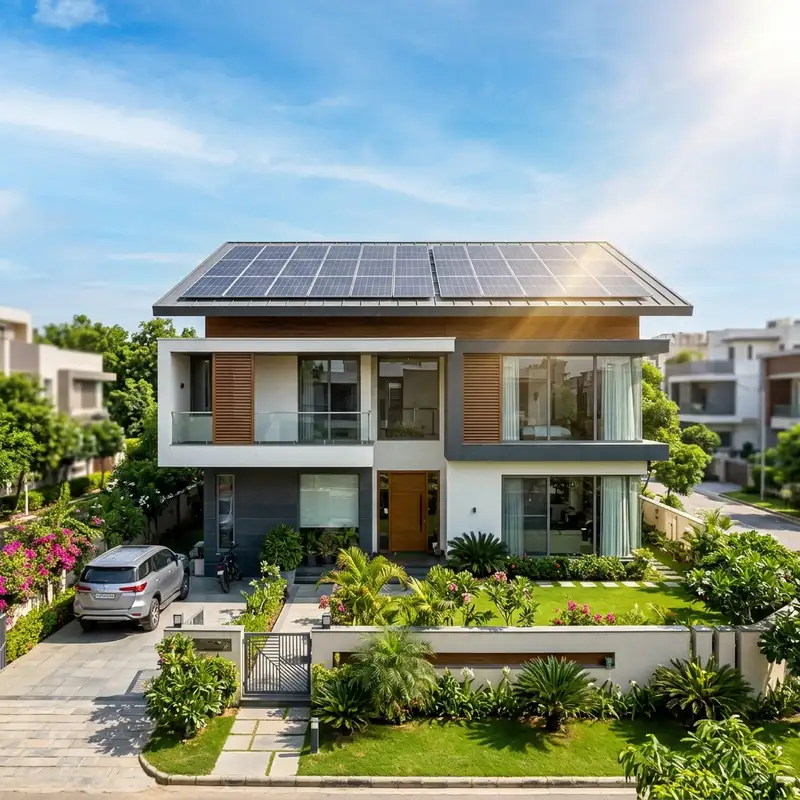
Residential rooftop solar installation on a modern home in Uttar Pradesh, stackable with UPNEDA state incentives.
2. How to Apply via UPNEDA and the National Portal
The application process has been integrated into a single pipeline to reduce delays. You do not need to apply on separate state websites:
- Access the official portal at pmsuryaghar.gov.in and register using your UPPCL consumer number (e.g., PVVNL or MVVNL account).
- Once your application is submitted, UPNEDA (UP New and Renewable Energy Development Agency) field teams receive the request and coordinate a site feasibility check.
- Select an approved installer registered in Uttar Pradesh. Check out our UP Registered Installers Directory to compare local vendor details.
- After the vendor completes the installation, they will upload the structural test certificates and the Domestic Content Requirement (DCR) form to the portal.
- Track your physical net-meter audit status using our PM Surya Ghar Status Checker.
- Once the Joint Inspection Report is signed by UPPCL engineers, the central subsidy is processed. UPNEDA then automatically disburses the ₹15,000 state subsidy to the same bank account within 45 days.
3. UPPCL Net Metering Guidelines & Billing Adjustments
Uttar Pradesh Power Corporation Limited (UPPCL) manages net metering via its local distribution divisions (PVVNL, DVVNL, MVVNL, and PuVVNL).
Billing Credits and Tariff Adjustments
UPPCL installs a bidirectional net meter that registers imported grid units and exported solar units. Any solar units exported to the grid are deducted from your monthly consumption ledger.
If your solar generation exceeds your consumption in a given month, UPPCL banks the surplus units. These banked units are carried forward month-on-month to offset bills during low-sunlight months (such as winter or during the monsoon).
Settlement Policies
At the end of the settlement year (which runs from October 1st to September 30th in Uttar Pradesh), UPPCL conducts a final review. Any accumulated excess units are purchased by UPPCL at the average power purchase rate determined by the state regulator (usually around ₹2.50 to ₹3.00 per unit). The cash value is credited to your next monthly billing cycle.
4. Project Costs and Payback Timelines in Uttar Pradesh
Homeowners in Uttar Pradesh pay high slab rates for grid consumption (frequently reaching ₹7.50 to ₹8.50 per unit for consumption above 300 units). This makes solar investment highly profitable.
For a typical **3kW solar system** costing ₹1,50,000, subtracting the ₹78,000 central subsidy and the ₹15,000 UP state subsidy leaves a net out-of-pocket cost of only **₹57,000**.
Generating approximately 360 units of solar electricity per month, a 3kW plant saves you roughly ₹3,000 monthly on grid bills. This results in a payback period of **19 months** (just over 1.5 years). To calculate your exact system requirements and payback timelines based on your current UPPCL bill, use our live Solar Cost Calculator.
5. Frequently Asked Questions
Here are answers to the most common queries about UP solar subsidies: