Are Solar Panels Worth It in 2026? A Complete Financial Analysis
Solar Savings Hub Editorial Team
Reviewed against DOE, SEIA & IRS sources
📅 Updated: 2026-10-04⏱️ 6 min read
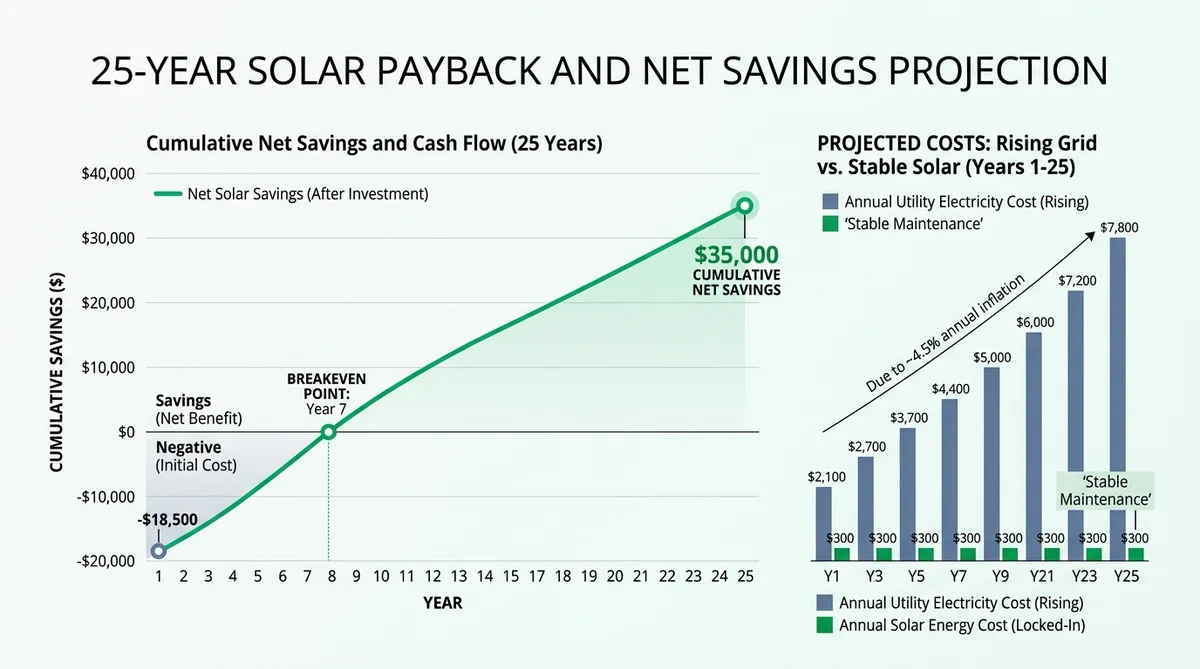
Financial analysis showing solar panel ROI, utility inflation offsets, and 25-year net savings projection
💡
Key Takeaways & Executive Summary
Hedge Against Inflation: US electricity rates have risen an average of 4-6% annually; solar locks in your energy rate for 25+ years.
8% to 15% Internal Rate of Return (IRR): Rooftop solar consistently outperforms traditional conservative investments.
$15,000+ Home Value Increase: Studies from NREL and Zillow show solar adds ~4% to home equity without raising property taxes in most states.
6 to 9 Year Payback: After breaking even, your system produces completely free electricity for the remaining 16-19 years of its warranty.
Avg Payback7.2 YrsNational Average
25-Yr Net Savings$32,000+After System Cost
Home Equity+4.1%Zillow Home Value Study
Lifespan25-30 YrsLinear Power Warranty
⚡ Quick Answer: Are Solar Panels Worth It in 2026?
Yes, solar panels are worth it for the majority of American homeowners who spend over $120 monthly on electricity. A standard 8 kW residential system pays for itself in 6 to 8 years, yielding an average 25-year net profit of $32,000 to $58,000 in eliminated utility bills.
With the 30% federal tax credit gone since December 2025, the math is tighter — but paired with an average +4.1% increase in home resale value, owned rooftop solar in high-rate states still hedges against 4%–6% annual utility rate hikes and delivers solid long-term returns.
Financial Verdict: Are Solar Panels Worth It for Your Home?
With residential utility electricity rates climbing over 22% nationwide since 2021, many homeowners ask: are solar panels worth it in 2026? The short answer is yes: for homes with unshaded roofs and monthly electric bills over $120, solar delivers an average 6- to 8-year payback and over $32,000 in net lifetime savings. However, determining your specific household return requires analyzing four fundamental criteria.
The 4-Point Solar Feasibility Test
Monthly Electric Bill Threshold: If your monthly electric bill averages under $90, your capital payback period will stretch beyond 10–12 years. Solar delivers maximum ROI for households spending $150 or more monthly.
Rooftop Sunlight & Shading: Your roof should receive at least 4 to 5 peak sun hours daily, facing South, Southwest, or West with minimal tree shading.
Roof Condition: If your asphalt shingle roof is more than 15 years old, replace the roof before installing solar panels to avoid paying $2,500–$4,000 later to detach and reinstall the panels.
Utility Net Metering Policy: Living in a state with favorable 1:1 net metering or strong SREC markets accelerates your payback timeline to 4 to 7 years.
Figure 1: 25-Year Solar Cash Flow & Net Savings Projection: Year 7 breakeven point and cumulative financial savings versus rising retail electricity inflation rates.
🧮 Calculate Your Exact Payback Timeline
Want to see how your specific electric utility bill, state net metering policy, and local solar insolation impact your break-even year? Run your numbers through our calibrated financial models:
Financing Comparison: Cash Purchase vs. Solar Loan vs. Lease / PPA
Table 1: Financial Return Comparison: Cash vs. Loan vs. Lease/PPA
Financing Option
Upfront Cost
Tax Credit Ownership
25-Year Net Savings
Home Equity Impact
Cash Purchase
100% Upfront
No credit in 2026 (ended)
$45,000 – $75,000+
Adds ~4.1% resale value
Low-Interest Solar Loan
$0 Down
No credit in 2026 (ended)
$30,000 – $55,000
Adds equity once paid off
Solar Lease / PPA
$0 Down
Third-party keeps ITC
$12,000 – $22,000
Can complicate home sales
With utility rates escalating across the country and the 30% federal tax credit ended since December 2025, evaluating whether solar panels are "worth it" comes down to simple mathematics: comparing what you will pay your electric utility over the next 25 years versus the fixed cost of owning your power.
1. The 25-Year Cost Comparison
If you pay an average of $175/month for electricity today, factoring in a conservative 4% annual utility rate increase means you will pay over $87,000 to your utility company over the next 25 years.
By comparison, installing an 8kW solar system costs ~$24,000 net in 2026 with no federal credit to claim. Once your system achieves payback in ~11 years, you generate free clean electricity for the remaining 14+ years of panel life—pocketing over $40,000 in net lifetime savings.
2. State-by-State Solar ROI: Where Are Panels Worth It Most?
Your location is one of the biggest determinants of whether solar panels are worth it. States with high electricity rates, strong net metering policies, and additional state tax credits now replace the former federal 30% ITC as the key accelerant of payback periods. The table below compares 7 key US markets using a standard 8kW system at $2.75/W installed cost.
Table 2: State Solar ROI Comparison — 8kW System, 2026 Data
State
Avg. Utility Rate
Net Cost After ITC
Payback Period
25-Year Net Savings
Net Metering Rating
Massachusetts
$0.29/kWh
$15,400
4.1 Years
$72,000+
⭐⭐⭐⭐⭐ Full 1:1 NEM
New Jersey
$0.20/kWh
$15,400
4.8 Years
$58,000+
⭐⭐⭐⭐⭐ Full NEM + SREC-II income
New York
$0.26/kWh
$15,400
5.2 Years
$62,000+
⭐⭐⭐⭐⭐ Full 1:1 NEM + NY-Sun incentive
Arizona
$0.15/kWh
$15,400
5.8 Years
$40,000+
⭐⭐⭐⭐ $1,000 state credit + RCP NEM
Florida
$0.16/kWh
$15,400
6.8 Years
$38,000+
⭐⭐⭐⭐ Full 1:1 NEM + 0% sales tax
California
$0.34/kWh
$15,400
7.5 Years (NEM 3.0)
$55,000+
⭐⭐⭐ NEM 3.0 ACC Export Rate
Texas
$0.14/kWh
$15,400
8.5 Years
$28,000+
⭐⭐ Varies (ERCOT buyback rates)
States with high electricity rates like Massachusetts ($0.29/kWh) and New York ($0.26/kWh) consistently deliver payback periods under 6 years and lifetime savings exceeding $60,000 — even without exceptional sun exposure. Lower utility rate states like Texas still offer positive 25-year ROI, though the payback period is longer.
3. When Are Solar Panels NOT Worth It? The 5 Warning Signs
Solar is not automatically the right choice for every homeowner. Here are five scenarios where the financial math does not favor solar in 2026, and what to do instead:
⚠
1. Heavily Shaded or North-Facing Roof: If more than 30% of your prime roof area is shaded between 9 AM and 3 PM by trees or neighboring buildings, your system output will be severely degraded, extending payback to 12-15+ years. A professional shading analysis is mandatory before signing any contract.
⚠
2. Electric Bill Under $90/Month: If your monthly electric bill consistently stays below $90, your annual electricity spend of roughly $1,080 means an $15,000 net system requires over 13 years to pay back, eating deeply into the earnings window before panel output degrades.
⚠
3. Planning to Move Within 5 Years: While solar adds approximately 4.1% to home resale value, the premium may not compensate for a remaining loan balance on a young system. Conduct a full NPV calculation before committing if relocation is likely within 5 years.
⚠
4. Aging Roof Under 15 Years of Useful Life: Installing solar on a near-end-of-life roof creates expensive future problems. Solar panel removal and reinstallation for a roof replacement typically costs $1,500-$4,500 — see our full R&R cost guide. Always replace a failing roof before installing solar.
⚠
5. Signing a Solar Lease / PPA Without Comparing Post-Credit Math: In Massachusetts, New York, or New Jersey — states with strong net metering — buying still usually beats leasing on lifetime value and home equity. But note the 2026 inversion: third-party-owned systems are now the only ones that can still carry a federal credit (Section 48E), so compare lease/PPA offers against post-credit purchase economics instead of dismissing them outright. Watch 20-25 year escalator clauses either way.
4. Solar vs. Other Investments: The After-Tax IRR Comparison
Rooftop solar is often undervalued as a pure financial investment. For a $15,000 net cash purchase in Massachusetts (4.1 year payback, $72,000 lifetime savings), the after-tax Internal Rate of Return (IRR) significantly outperforms conventional options because solar savings are completely tax-free:
Table 3: Solar vs. Investment Vehicles — 25-Year After-Tax Return ($15,000 Initial)
Investment Type
Avg Annual Return
25-Year Gross Value
Tax Treatment
Risk Level
Rooftop Solar (MA)
10-14% IRR
$72,000 savings
100% Tax-free
Very Low
S&P 500 Index Fund
10.5% avg
~$61,000
Capital gains tax (15-20%)
Medium-High
10-Year US Treasury Bond
4.5-5.0%
~$32,000
Taxable income
Very Low
High-Yield Savings (HYSA)
4.5-5.0%
~$32,000
Taxable income
Very Low
Solar savings are completely tax-free, while investment gains trigger capital gains taxes at 15-20%. This makes rooftop solar one of the highest after-tax return opportunities available to American homeowners today — especially when combined with a state with strong net metering policy and an electric bill above $150/month.
Calculate Your Exact Solar Payback Period
Use our free Solar Payback Calculator — enter your monthly electric bill, system size, and state for a precise ROI projection based on your real-world inputs.
What happens if I sell my home before the solar panels are paid off?
If you own the panels, studies show homes with solar sell faster and for a ~4% premium. You can transfer any remaining loan balance to the buyer or pay it off with the increased proceeds from your home sale.
Do solar panels increase property taxes?
In 38 states across the US, statutory property tax exemptions legally protect homeowners by exempting 100% of the added home value created by solar energy systems from local property tax assessments.
What is the typical break-even payback period for home solar in the US?
Nationwide, the average solar payback period ranges from 5 to 8 years. In high-cost utility states like California, Massachusetts, and New York, payback can be as fast as 3.5 to 5.5 years.
Is it better to buy solar panels outright or take a solar loan?
Cash purchase delivers the highest lifetime return — up to $75,000+ in savings — but requires significant upfront capital. A low-interest solar loan at 4.99% APR (from GreenSky, Mosaic, or a local credit union) still nets $30,000-$55,000 in lifetime savings with $0 down. Neither option carries a federal credit in 2026 — and the old advice has inverted: leases and PPAs are now the only path with a federal credit attached (Section 48E, claimed by the system owner). Compare all three paths on post-credit numbers.
Is there still a federal solar tax credit in 2026?
No — not for homeowner systems installed in 2026. The 30% Residential Clean Energy Credit (Section 25D) ended December 31, 2025 under the One Big Beautiful Bill Act. The remaining federal path is Section 48E for third-party-owned lease/PPA systems. See our 2026 tax credit guide for the full breakdown.
What is the lifespan of modern solar panels and what warranties should I expect?
Premium N-Type TOPCon and PERC panels from Tier-1 manufacturers — SunPower, Qcells, REC, Canadian Solar — carry a 25-year product warranty and a 25-30 year linear power output warranty, guaranteeing no more than 0.4-0.5% annual degradation. After 25 years, high-quality panels typically still produce 88-92% of their original rated output. The inverter is most likely to require replacement after 10-15 years, at a cost of $1,800-$3,500 for a string inverter swap or microinverter replacement.