

⚡ Quick Answer: What is California NEM 3.0?
NEM 3.0 (officially called the Net Billing Tariff) is the solar billing rule for California homeowners served by PG&E, SCE, and SDG&E. Under NEM 3.0, the credit power companies pay you for sending extra solar power to the electric grid was cut by about 75%—dropping from roughly 30 cents per kilowatt-hour down to an average of just 5 to 8 cents.
Because selling power back to the grid now earns pennies while buying electricity at night costs 50 to 60+ cents, adding a home battery (like a Tesla Powerwall 3 or Enphase IQ 5P) is essential. A solar-plus-battery system lets you store your own power during the day and use it at night, paying for itself in 6 to 8 years.
If you live in California and your electric bill from PG&E, Southern California Edison, or SDG&E keeps climbing every year, you have probably heard people say that "solar is dead" because of NEM 3.0. That is simply not true. What actually happened is that the rules of the game changed. Once you understand how the new rules work, you can still slash your electric bill by 70% to 90%.
1. What is NEM 3.0? (The Simple Explanation)
To understand NEM 3.0, imagine you have a garden that grows way more tomatoes than your family can eat during lunch.
Under the old rule (called NEM 2.0, which ended in April 2023), the local grocery store agreed to buy every extra tomato you grew for $3.00. Then, when dinner rolled around, they sold tomatoes back to you for the exact same $3.00. It was an even, fair 1-for-1 trade. Because of that trade, homeowners did not need batteries. The electric grid acted like a giant free battery.
Under the new rule (called NEM 3.0 Net Billing), the rules flipped completely. Now, when your solar panels make extra electricity at 1:00 PM and send it to the utility company, the power company only gives you about 5 to 8 cents per unit (kWh). But when the sun goes down at 7:00 PM and you need electricity to cook dinner, run the TV, and turn on the air conditioner, that same utility company charges you 50 to 60+ cents per unit!
Obviously, selling something for 5 cents and buying it back two hours later for 50 cents is a terrible deal. That is why California homeowners must stop sending extra electricity to the power company. Instead, you keep that electricity in your own home using a battery.
2. Net Metering vs. Net Billing: Side-by-Side Comparison
The table below breaks down the exact differences between how California used to bill solar vs. how it works today in 2026:
| Feature | NEM 2.0 (Old System) | NEM 3.0 (2026 Rules) | What It Means For You |
|---|---|---|---|
| Official Name | Net Energy Metering (NEM) | Net Billing Tariff (NBT) | Shift from metering to utility wholesale pricing |
| Daytime Export Credit | ~30¢ to 38¢ / kWh | ~5¢ to 8¢ / kWh | Export credit slashed by roughly 75% |
| Need for a Battery | Optional luxury | Essential for good ROI | Batteries store extra daytime power for night |
| Solar-Only Payback | 4 to 6 Years | 10 to 14 Years | Installing solar without a battery is not recommended |
| Solar + Battery Payback | 7 to 9 Years | 6 to 8 Years | Beats rising electric rates (climbing 6-9%/year) |
| Grandfathering Term | 20 Years from PTO | 9-Year Locked Export Schedule | Protects your export credit rates for 9 years |
3. How the Big 3 California Power Companies Handle NEM 3.0
NEM 3.0 applies directly to California's three giant Investor-Owned Utilities (IOUs): Pacific Gas & Electric (PG&E) in Northern California, Southern California Edison (SCE) in Central and Southern California, and San Diego Gas & Electric (SDG&E) in San Diego and South Orange County.
If you are powered by a municipal utility (like LADWP in Los Angeles or SMUD in Sacramento), NEM 3.0 does not apply to you because those public utilities have their own separate solar policies.
| Utility Company | Mandatory NEM 3.0 Rate Plan | Off-Peak Rate (Cheap Hours) | Peak Rate (4 PM - 9 PM) | Avg Solar Export Credit |
|---|---|---|---|---|
| PG&E | E-ELEC (Electrification) | ~$0.34 / kWh | ~$0.54 – $0.62 / kWh | ~$0.05 / kWh |
| SCE | TOU-D-PRIME | ~$0.26 / kWh | ~$0.56 – $0.64 / kWh | ~$0.06 / kWh |
| SDG&E | EV-TOU-5 | ~$0.16 / kWh (Super Off-Peak) | ~$0.68 – $0.82 / kWh | ~$0.04 – $0.07 / kWh |
4. How Solar + Battery Works Under NEM 3.0 (The Visual Workflow)
To win under NEM 3.0, your daily energy routine splits cleanly into two parts: Daytime and Evening Peak. The visual diagram below shows exactly how your home handles solar power:
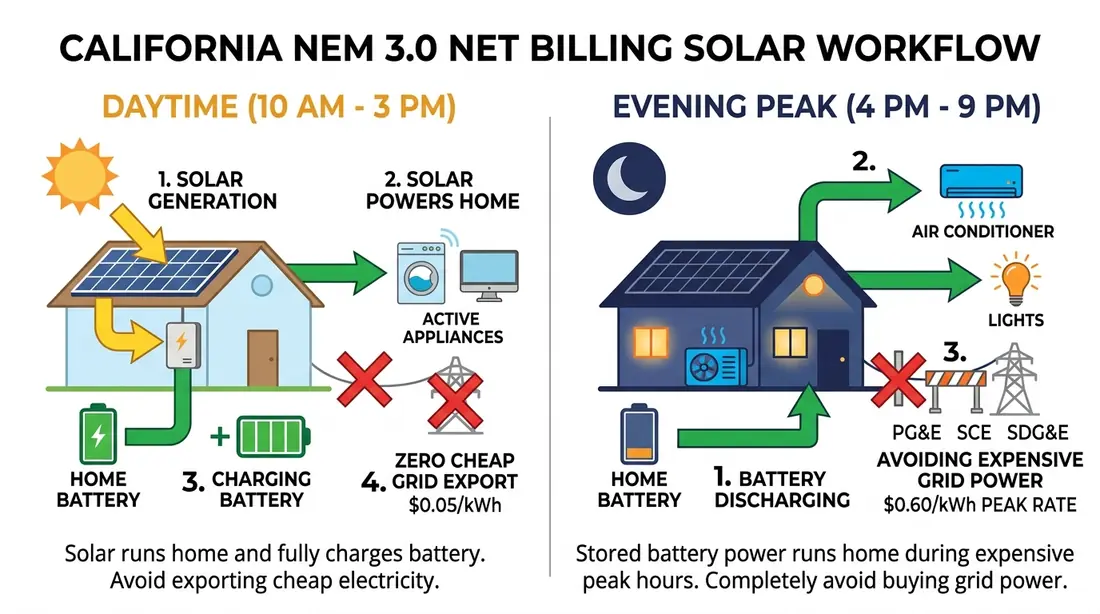
The Self-Consumption Cycle: Solar charges your battery during the afternoon, and the battery powers your home at night to avoid high peak electric bills.
- Morning & Afternoon (10:00 AM – 3:00 PM): Your solar panels produce maximum power. First, the electricity runs your refrigerator, washing machine, and home Wi-Fi. Second, all excess power charges your home battery (such as a Tesla Powerwall 3 or Enphase 5P). Because your battery drinks up all the extra power, almost nothing is sent to the utility grid for pennies.
- Evening Peak (4:00 PM – 9:00 PM): The sun sets, and solar panels stop producing. At this exact moment, California power companies raise electric prices to their highest levels (up to 60¢ to 80¢ per kWh). Your home battery automatically takes over. It powers your lights, TV, and air conditioner throughout the evening. You buy zero electricity from the power company.
- Overnight (9:00 PM – 6:00 AM): Rates drop back down to off-peak pricing. Your home continues using remaining battery power or pulls low-cost off-peak power until the sun comes up the next morning.
5. The "September Bonus": How to Earn $3.00/kWh Export Credits
While regular daytime export rates are low, the state's Avoided Cost Calculator (ACC) contains an exciting hidden secret: extreme price spikes during hot summer evenings.
During late August and September, heatwaves hit California. Everyone comes home from work and turns on their air conditioning at 6:00 PM. This strains the electrical grid and threatens blackouts. To prevent power outages, California utilities offer massive bonus export credits—sometimes reaching $2.50 to $3.50 per kilowatt-hour between 7:00 PM and 8:00 PM!
Modern smart batteries (like the Tesla Powerwall 3) have automated "Virtual Power Plant" (VPP) software built in. If you enable this feature, your battery will hold its charge during the day and automatically dump power back into the grid during those few golden September hours, earning you $150 to $400 in direct bill credits during a single summer month!
6. Solar-Only vs. Solar + Battery: The True 25-Year Numbers
Many homeowners ask: "Can I just buy solar panels now and skip the battery to save money upfront?" Here is what the real math looks like for a typical 8 kW home system in California:
| Comparison Metric | Option A: Solar-Only (8 kW) | Option B: Solar + Battery (8 kW + 13.5kWh) |
|---|---|---|
| Gross System Price | $24,000 | $35,500 (Panels + Tesla Powerwall 3) |
| Federal Tax Credit (2026) | $0 | $0 |
| Net Upfront Out-of-Pocket | $24,000 | $35,500 |
| First-Year Electric Savings | ~$1,450 / year | ~$3,600 / year |
| Break-Even Payback Timeline | 11.5 Years | 6.8 Years |
| Protection Against Blackouts | No (Shuts off during grid outages) | Yes (Keeps food cold, lights on) |
| 25-Year Net Lifetime Profit | ~$28,000 | ~$74,000+ |
Even though adding a battery increases your initial cost by around $8,000 net, it more than doubles your annual electric bill savings. Because you avoid buying expensive evening power from PG&E, SCE, or SDG&E, the battery actually makes your solar system pay for itself almost 5 years faster!
7. How to Size Your Battery and Panels for NEM 3.0
Under the old rules, solar salespeople would size your system as big as possible to sell maximum electricity to the grid. Under NEM 3.0, that is a mistake.
- Don't Oversize Panels: Only build enough solar capacity to match your home's actual 24-hour electric consumption plus 10% for cloudy winter days. Any extra daytime generation beyond what your home uses and your battery stores will be sold for 5 cents, delivering near-zero financial return.
- Match Battery to Evening Usage: Check your utility bill or smart meter data to see how many kilowatt-hours you consume between 4:00 PM and midnight. For most homes, a single 13.5 kWh battery (like a Tesla Powerwall 3) covers 100% of evening demand. Homes with two central air conditioners or electric vehicle charging usually benefit from two batteries (20 to 27 kWh).
Calculate Your California Solar & Battery Savings
Enter your monthly PG&E, SCE, or SDG&E electric bill to calculate your exact NEM 3.0 solar-plus-storage payback timeline: