Solar Panel Critter Guards & Bird Proofing: The Complete 2026 Guide
Solar Savings Hub Editorial Team
Reviewed against DOE, SEIA & IRS sources
📅 Updated: 2026-10-04⏱️ 9 min read
Technician installing black PVC-coated galvanized steel wire critter guard mesh around residential solar array perimeter
💡
Executive Summary & Key Takeaways
The Wildlife Threat: Pigeons nest in the shaded space beneath solar panels, leaving corrosive droppings and lice, while squirrels chew DC wiring insulation, causing arc faults and system shutdowns.
Average Installation Cost: Professional critter guard installation costs between $750 and $2,000 ($8 to $15 per linear foot) depending on roof pitch and array size.
PVC-Coated Steel Mesh: The industry standard is 1/2-inch black PVC-coated galvanized steel wire mesh secured with specialized non-drilling solar panel fastening clips.
Zero-Drill Warranty Protection: Never drill into solar panel aluminum frames to screw down mesh, as this instantly voids manufacturer product and structural warranties.
Avg Guard Cost$850-$1,750Typical 20-Panel Array
Mesh MaterialPVC Steel1/2" Galvanized Wire
Fastener TypeNo-Drill ClipsProtects Warranty
Fire Risk Reduction99%Prevents Wire Chewing
⚡ Quick Answer: How Much Do Solar Panel Critter Guards Cost?
Installing professional solar panel critter guards costs between $750 and $2,000 (averaging $8 to $15 per linear foot) for a typical 20-panel (8 kW) residential array.
The industry standard system uses 1/2-inch black PVC-coated galvanized steel wire mesh fastened with non-drilling J-hook clips. This physical barrier blocks pigeons from nesting and stops squirrels from chewing DC solar cables, preventing $2,500+ inverter fire repairs without voiding your 25-year panel warranty.
Installing durable solar panel critter guards is essential for protecting rooftop solar arrays from wildlife infestation. Rooftop solar panels create an ideal 4- to 6-inch micro-environment for wildlife. The sheltered space provides protection from rain, wind, and predators, while radiant heat from solar inverters creates an inviting habitat. Without protective critter guards, birds and squirrels can cause catastrophic electrical failures and structural damage.
1. The Two Primary Wildlife Threats to Solar Arrays
A. Pigeons & Nesting Birds
Pigeons and starlings are notorious for colonizing solar arrays. A single flock can deposit pounds of acidic guano per week, corroding electrical junction boxes, creating fire hazards with dry nesting twigs, clogging roof drainage gutters, and generating severe odor and feather-mite infestations inside attic spaces.
B. Squirrels & Rodents (The Arc Fault Danger)
Squirrels have continuously growing incisors and instinctively gnaw on high-voltage DC solar cabling under panels. Exposed copper conductors cause dangerous Ground Isolation Faults and high-temperature electrical arc faults, triggering instant inverter shutdown and posing a severe roof fire hazard.
2. Solar Panel Critter Guards: Materials, Fasteners, & Installation Standards
Quality critter guards must withstand decades of extreme weather and determined wildlife. Vetted installation standards require:
1/2" x 1/2" Galvanized Steel Wire Mesh: Coated in UV-resistant black PVC for aesthetic blending and rust prevention.
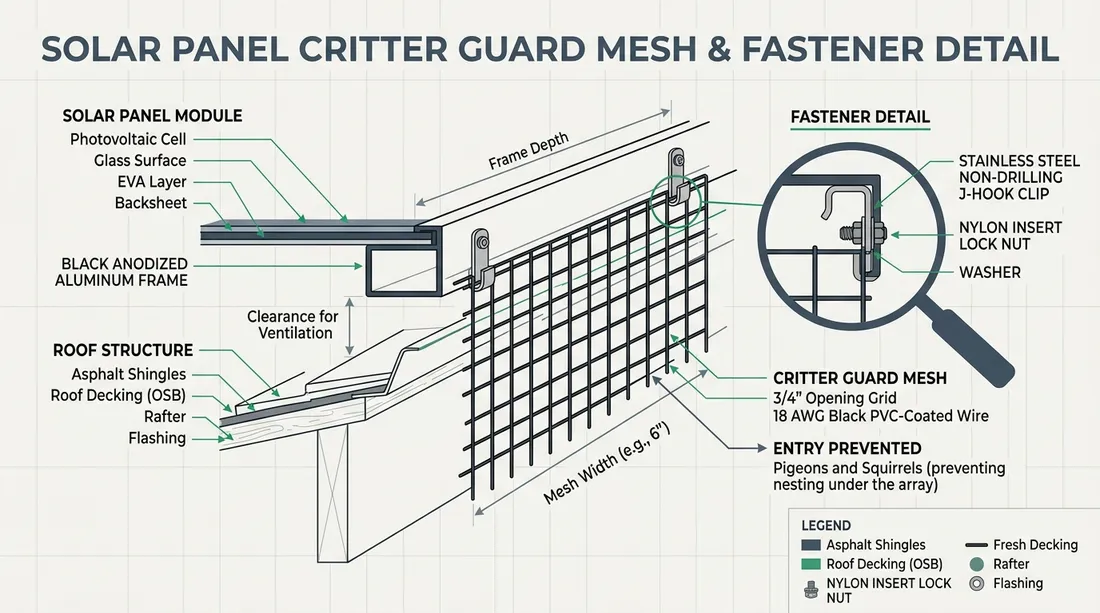
UV-Resistant Nylon & Stainless Steel Fastening Clips: Clips lock securely onto the inside lip of the solar panel aluminum frame using a locking washer, requiring zero drilling or sheet-metal screws that would void your panel warranty.
Corner Flashing & Valleys: Specialized flared mesh sections that contour tightly to tile roof ridges or standing-seam metal ribs.
Figure 1: Engineering Detail: Solar Panel Critter Guard Mesh & Fastener Installation using non-drilling stainless steel J-hook clips and lock nuts.
🔧 Related Solar Maintenance & Repair Guides
Dealing with damaged rooftop wiring, broken roof tiles, or needing to remove panels for repairs? Review our companion technical guides:
Installing barrier mesh around your solar array must not impede rooftop stormwater drainage or solar panel passive cooling:
Natural Convection Airflow: Wire mesh maintains over 85% open area, allowing natural air circulation beneath the panels. This keeps photovoltaic cells operating at cooler temperatures, preventing heat-induced efficiency losses.
Debris & Pine Needle Management: Quality mesh prevents leaves, pine needles, and storm twigs from accumulating into combustible debris dams under the array.
To ensure your critter guard barrier remains impenetrable across decades of weather extremes:
Annual Spring Inspection: Visually inspect the array perimeter from ground level or an extension ladder each spring, looking for loose clips or sagging mesh.
Gutter Cleaning Coordination: Ensure roofing and gutter cleaners do not hook ladders directly against the mesh guard edges.
Tree Branch Trimming: Trim back any overhanging tree branches within 6 to 8 feet of the roofline to prevent squirrels from jumping directly onto the array.
6. Professional Remediation vs. New Installation: Biohazard Decontamination
If pigeons or squirrels have already established a presence beneath your rooftop solar array, installing mesh barrier guards is only step two of a necessary three-step remediation process:
Biohazard Hazards of Pigeon Guano: Pigeon droppings harbor dangerous pathogenic fungal spores, notably Histoplasma capsulatum (which causes Histoplasmosis) and Cryptococcus neoformans. When dried pigeon guano is disturbed under hot roof conditions, microscopic airborne spores can enter household ventilation intakes and attic crawlspaces, posing severe respiratory hazards to residents.
Safe Debris Removal & Pressure Bio-Washing: Certified solar remediation technicians wear full personal protective equipment (PPE) including N95 or P100 respirators, protective suits, and heavy chemical gloves. Technicians carefully shovel and bag nesting debris, twigs, and droppings before applying an EPA-approved, non-toxic enzymatic bio-cleaner that sanitizes the roof membrane without degrading the solar panel backsheets or voiding manufacturer warranties.
Never Pressure-Wash Dry Guano: Blasting dried bird droppings with high-pressure water pulverizes bacteria into an airborne aerosol and forces slurry water into delicate MC4 electrical connectors and junction box seals. Proper cleaning requires pre-soaking with gentle anti-microbial solutions followed by low-pressure rinsing.
When squirrels nest beneath solar panels, their continuously growing incisors compel them to gnaw on rubber, plastic, and insulation. Solar DC cables (operating at 300 to 600 Volts DC) are frequent targets:
Damage Severity
System Symptom
Correct Code-Compliant Repair Method
Superficial Jacket Gnawing
Intermittent morning "ISO Fault" error on inverter during damp weather
If copper strands are completely undamaged, technician wraps area with self-amalgamating waterproof silicone tape followed by UV-rated heat-shrink tubing.
Severed or Frayed Copper
Permanent Ground Fault shutoff; arc fault alert; dead string
Cut damaged section and crimp certified male/female Staubli MC4 connectors to restore continuity; or pull a brand new continuous homerun PV cable back to the junction box.
Chewed Module Lead / Junction Box
Panel output 0W; melted bypass diode or charred backsheet
If the short lead entering the sealed module junction box is damaged, the entire solar panel must be unbolted and replaced under manufacturer safety protocols.
8. Homeowners Insurance, Solar Warranties & Financial Payback
Understanding who pays for wildlife damage and how critter guards protect your long-term investment is critical for every homeowner:
Homeowners Insurance Exclusions: Most standard homeowner insurance policies (HO-3 and HO-5) contain explicit exclusion clauses for "damage caused by rodents, vermin, birds, or insects." While fire damage resulting from a squirrel arc fault may be covered, the electrical repair bills, chewed wiring replacement, and lost generation are almost always rejected by insurance adjusters unless you have a dedicated solar equipment rider.
Manufacturer Warranty Protection: Solar panel warranties strictly cover manufacturer defects and linear power degradation. Damage from animal nesting, chewed cabling, or corrosion from accumulated bird feces is completely excluded. Installing critter guards preserves your 25-year manufacturer warranty.
Return on Investment (ROI): A professional critter guard installation costs approximately $850 to $1,750 for a typical 20-panel array. In contrast, diagnosing and repairing a single squirrel wire chew requires 3 to 6 hours of solar technician labor ($600 to $1,200), panel removal and reinstallation ($400 to $800), and weeks of lost summer solar production ($150 to $300). Critter guards typically pay for themselves the first time they prevent a single wildlife incident.
9. DIY vs. Professional Installation: Cost & Safety Comparison
While DIY critter guard rolls can be purchased online for $150 to $300, homeowners should carefully weigh the true costs before attempting a self-installation:
Roof Pitch & Fall Hazards: Solar arrays are typically installed on the sunniest, unshaded upper roof planes—frequently second-story roofs with steep 6/12 to 10/12 pitch angles. Professional installers utilize full OSHA-compliant fall-arrest systems, including roof anchors, body harnesses, and shock-absorbing lanyards.
Delicate Roofing Membranes: Walking incorrectly on Spanish clay tiles, concrete S-tiles, or standing seam metal roofs will crack tiles or dent panels, leading to costly interior water leaks during the next storm. Professionals know how to distribute weight using foam cushions or walkboards.
High-Voltage DC Exposure: Working with metal wire mesh within inches of 400V–600V DC conductors requires strict electrical safety awareness. A snagged mesh wire contacting a partially degraded cable can create an instant shock or arc flash hazard.
Frequently Asked Questions
Can I install critter guards myself as a DIY project?
While DIY mesh kits are available online for $200 to $400, working on high-pitch roofs near high-voltage DC solar wiring involves severe fall and electrical shock risks. Professional installation ensures proper safety harnesses and zero panel damage.
Does installing critter guards void my solar panel warranty?
No, provided the installer uses non-drilling frame J-hook fastening clips. Drilling holes directly into the panel aluminum frame will immediately void the manufacturer warranty.