When you invested thousands of dollars in a rooftop solar system, your installer probably told you: "Solar panels are maintenance-free! Whenever it rains, they clean themselves!"
While rain does wash away loose dust, it cannot remove sticky spring pollen, baked-on bird droppings, road grime, or oily wildfire ash. Over time, this thin film of grime—known in the solar industry as soiling—acts like a permanent set of dark sunglasses sitting on top of your solar cells. In 2026, keeping your solar panels clean is the single easiest way to put an extra $200 to $450 of electric bill savings back in your pocket every single year.
1. How Much Power Do Dirty Panels Actually Lose? (The Data)
Extensive field studies conducted by the National Renewable Energy Laboratory (NREL) reveal that uncleaned residential solar arrays lose between 5% and 25% of their total energy generation depending on where you live and the surrounding environment:
| Environment / Climate Zone | Primary Soiling Contaminants | Annual Output Loss | Recommended Cleaning Schedule |
|---|---|---|---|
| Rainy Suburban (Pacific NW, Northeast) | Tree pollen, moss spores, light dust | 3% – 7% | Once every 12 months (late Spring) |
| Arid Desert (Arizona, Nevada, SoCal) | Blowing sand, fine mineral dust, zero rain | 15% – 25% | Twice per year (April & October) |
| Agricultural / Farm Belts (Central Valley, Midwest) | Harvest dust, fertilizer dust, heavy bird traffic | 18% – 30% | 3 to 4 times per year |
| Wildfire & Smoke Impact Zones (West Coast) | Oily hydrocarbon soot, ash deposits | 20% – 35% | Immediately after fire/smoke season |
🐦 Why a Single Bird Dropping Is Worse Than a Layer of Dust
Solar panels are divided into internal electrical strings connected by bypass diodes. When fine dust covers an entire panel evenly, output drops slightly across the whole array. But when a bird leaves an opaque white dropping on just one single cell, that entire string shuts off to protect against overheating (called a hotspot). That one bird dropping can knock out 33% of that panel's entire electricity output until it is scrubbed off!
2. The 6-Step Safe DIY Cleaning Protocol
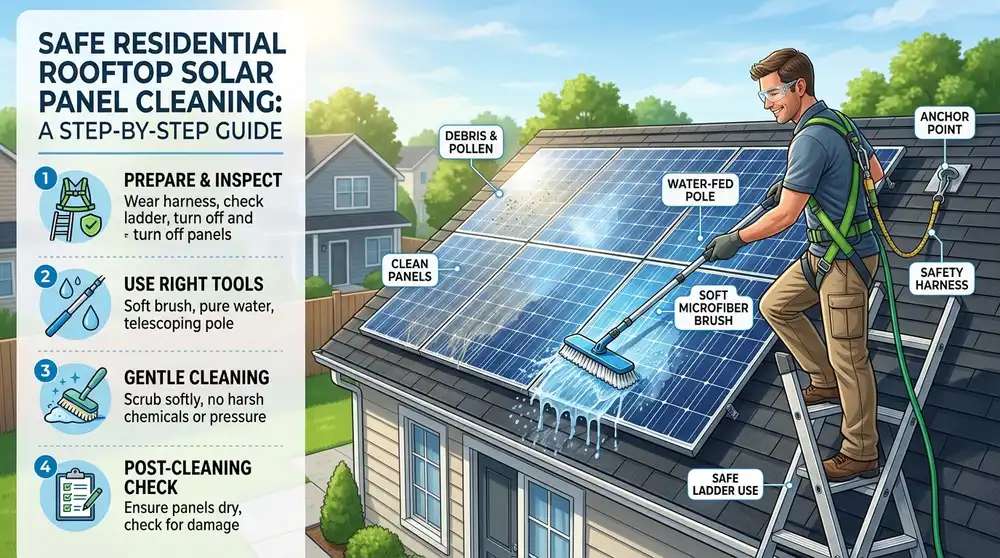
You do not need an expensive contractor to clean single-story roofs. You can safely clean your solar array yourself in about an hour following this six-step protocol:
- Step 1: Pick the Right Time (Early Morning or Evening): Never spray water on solar panels in the middle of a sunny day! When solar panels are working in direct sunlight, the glass can reach 150°F to 165°F (65°C to 75°C). Spraying cold 55°F tap water onto baking-hot glass causes thermal shock, which can shatter the tempered glass instantly. Wash early before 9:00 AM or after the sun goes down.
- Step 2: Turn Off the Solar Inverter: As an electrical safety precaution, go to your solar AC disconnect switch or circuit breaker panel and switch the solar system OFF. This eliminates any risk of electrical shorting while water is running across the roof.
- Step 3: Assemble Safe Cleaning Tools: You will need a lightweight water-fed telescoping extension pole (12 to 24 feet), a soft microfiber brush head, a rubber squeegee, and a garden hose with a standard brass spray nozzle.
- Step 4: Pre-Rinse with Low Pressure Water: Gently spray the panels from top to bottom with your garden hose. This loosens dried dust and washes away grit so you do not drag sharp sand particles across the glass during scrubbing.
- Step 5: Scrub Gently with Pure Water or Mild Soap: Using your extension pole, gently scrub the glass surface in smooth strokes. For stubborn spots (like bird droppings or tree sap), mix a few drops of mild dish soap (like original Dawn) in warm water. Never scrub with steel wool, wire pads, or rough sponges.
- Step 6: Squeegee Dry to Prevent Mineral Spots: If your tap water has high mineral content (hard water), drying in the sun will leave white calcium spots. Use a rubber squeegee attached to your extension pole to pull the water down the face of the panels, leaving the glass crystal clear. Turn your inverter back ON!
3. Big Mistakes That Will Void Your 25-Year Warranty
Solar panel glass is coated with an ultra-thin microscopic film called an Anti-Reflective Coating (ARC). This coating traps photons so sunlight enters the silicon cells instead of bouncing off like a mirror. Avoid these four common mistakes that can permanently damage this coating and void your warranty:
- ❌ Never Use a Pressure Washer: High pressure water jets (1,500 to 3,000 PSI) will blow past the silicon perimeter seals, force water into electrical junction boxes, and cause internal short circuits. Only use gentle garden hose pressure (under 40 PSI).
- ❌ Never Use Windex, Bleach, or Vinegar: Harsh chemical cleaners, ammonia, vinegar, and abrasive powders eat away the anti-reflective coating. Once this coating is corroded, your panels will permanently lose 5% to 8% of their light-absorption capability.
- ❌ Never Walk or Step on Solar Panels: Never stand or lean your knee on a panel! While the tempered glass can support snow loads, human point-pressure causes invisible internal micro-cracks in the fragile silicon wafers underneath the glass.
- ❌ Never Scrape with Metal or Hard Plastic Tools: Metal razor scrapers and stiff bristle brooms scratch the glass, creating permanent shadows and refractive flaws that degrade solar yields.
4. DIY vs Professional Solar Cleaning: Real Cost Comparison
Should you wash your panels yourself or hire a professional? Here is how the numbers break down:
| Category | DIY Cleaning | Professional Solar Cleaner |
|---|---|---|
| Upfront Equipment Cost | $60 – $140 (One-time tool purchase) | $0 (Contractor provides tools) |
| Cost Per Cleaning Visit | $0 (Free labor) | $150 – $350 per visit ($10–$18/panel) |
| Water Purification Quality | Standard tap water (or hose filter) | 100% Deionized reverse-osmosis water (zero spots) |
| Safety Risk | Moderate to High (Ladder falls, roof slips) | Zero risk to homeowner (Fully insured crews) |
| Best Suited For | Single-story homes with low-pitch roofs | 2-story homes, steep tile roofs, large 30+ panel arrays |
5. Winter Maintenance: How to Clear Snow Without Scratches
In colder northern states (such as New York, Massachusetts, and Colorado), winter snow covers solar arrays and temporarily drops generation to zero. Here is how to handle snow:
- The Natural Melt Effect: Because solar panels are tilted and have smooth glass, dark silicon cells heat up quickly as soon as a sliver of morning sunlight hits them. In most cases, snow naturally slides off in large sheets within 24 to 48 hours without any human intervention.
- Use a Specialized Foam Snow Rake: If you want to clear heavy snow to restart electricity production immediately, buy a telescoping foam snow rake (such as the SnoBrum). Never use a metal or hard plastic shovel, which will gouge the glass and damage aluminum frames.
- Never Throw Salt or Boiling Water: Rock salt corrodes aluminum frames, and boiling water causes instant thermal shock that shatters the glass. Let nature and a gentle foam rake do the work.