
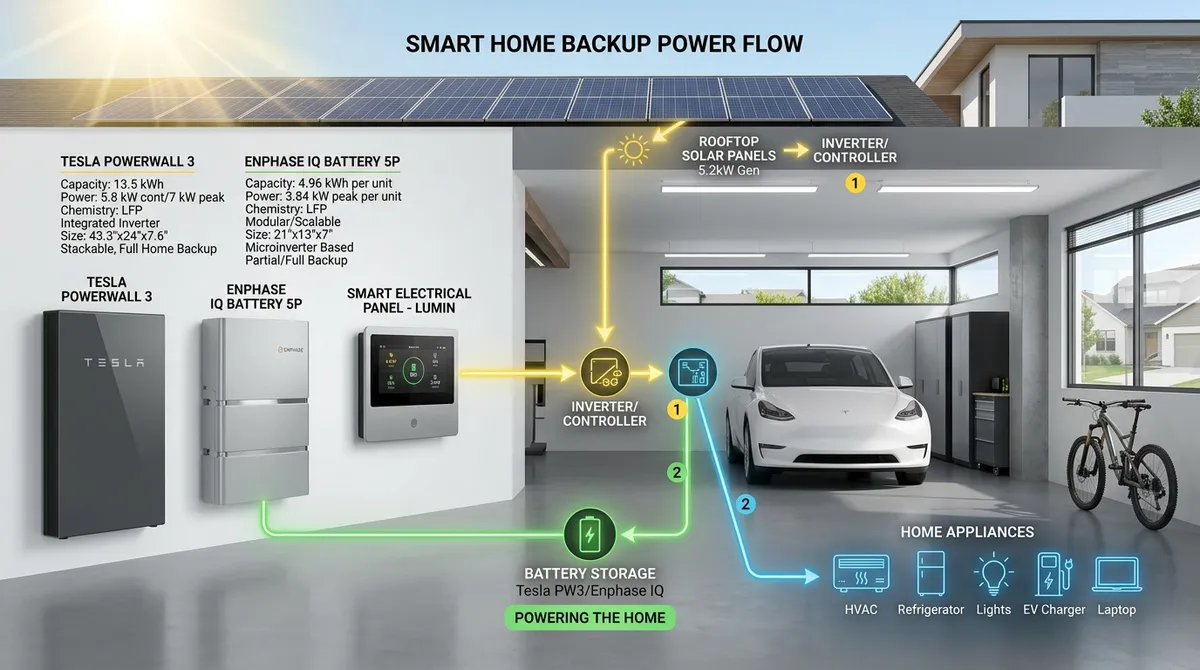
A few years ago, putting a battery in your garage felt like a pricey gadget for tech lovers or people living off the grid in the woods. In 2026, that has completely changed. Utility companies from California to Texas and New York have cut back traditional 1-to-1 net metering, electricity prices during hot summer evenings are soaring, and severe heatwaves and winter storms knock out the power grid more frequently than ever.
If you have solar panels on your roof without a battery, you might be surprised to learn that your lights still turn off when the power grid goes down. By law, standard solar systems must shut down during a blackout so they do not accidentally send electricity through power lines and injure repair crews. Adding a battery backup system keeps your home powered safely, protects your food and medicines, and lets you store your own cheap solar electricity to use whenever utility rates spike.
1. 2026 Home Battery Shootout: Side-by-Side Specs
To help you cut through sales pitches, our team evaluated the top five residential battery storage systems installed in American homes this year. Here is how they stack up across capacity, power, chemistry, and warranty coverage:
| Battery Model | Usable Storage | Continuous Power | Peak Surge (10s) | Chemistry | Warranty | Estimated Installed Cost |
|---|---|---|---|---|---|---|
| Tesla Powerwall 3 | 13.5 kWh | 11.5 kW | 18.5 kW | LFP | 10 Years (70% retention) | $12,500 – $14,500 |
| Enphase IQ Battery 5P | 5.0 kWh (Modular) | 3.84 kW per unit | 7.68 kW (3 sec) | LFP | 15 Years (Industry Best) | $7,500 (1x) / $15,000 (2x) |
| FranklinWH aPower | 13.6 kWh | 5.0 kW | 10.0 kW | LFP | 12 Years (43 MWh throughput) | $14,000 – $16,500 |
| SolarEdge Home Battery | 9.7 kWh | 5.0 kW | 7.5 kW | LFP | 10 Years (70% retention) | $11,500 – $13,500 |
| Generac PWRcell | 9.0 – 18.0 kWh | 4.5 – 9.0 kW | 12.0 kW | NMC / Li-ion | 10 Years | $15,000 – $18,500 |
2. Simple Explanation: Kilowatts (kW) vs Kilowatt-Hours (kWh)
One of the most confusing parts of shopping for a solar battery is understanding the two numbers installers always mention: kW and kWh. An easy way to understand this is to picture a simple garden water tank:
- Kilowatt-hours (kWh) = The size of your water tank: This tells you how much total energy the battery can hold. If your battery holds 13.5 kWh, that is your energy reservoir. If your home uses 1 kilowatt of electricity every hour (running lights, a fridge, and a TV), a 13.5 kWh tank will last you about 13.5 hours.
- Kilowatts (kW) = The thickness of the pipe coming out of the tank: This tells you how fast energy can flow out of the battery at any single second. If you have a huge water tank but a tiny straw for an outlet, you cannot fill a five-gallon bucket quickly. In your home, starting a central air conditioning unit or turning on an electric oven requires a big rush of power (lots of kW).
This is why the Tesla Powerwall 3 stands out so much in 2026. Older batteries like the Powerwall 2 could only push out 5.0 kW continuously. If your AC kicked on while you were microwaving dinner, the battery would get overwhelmed and force your house to draw power from the grid. The Powerwall 3 pushes out 11.5 kW of continuous power, which is enough to start and run a whole-house central air conditioner without breaking a sweat.
3. Battery Sizing Guide: How Much Storage Do You Actually Need?
Before spending tens of thousands of dollars on batteries, decide what you really need to power when the electricity cuts out. Home energy backup generally falls into two tiers:
Tier 1: Essential Loads Backup
Keeps your life comfortable and safe during blackouts without paying for unnecessary battery capacity.
- Kitchen refrigerator & freezer (protects food)
- Wi-Fi router, phones, and laptops
- Living room, kitchen, and bathroom LED lights
- Garage door opener & home security cameras
- Medical devices (CPAP machines, monitors)
Tier 2: Whole-Home Backup
Powers heavy 240V appliances so you hardly notice the neighborhood power grid is down.
- 3 to 5-ton central air conditioning or heat pump
- Electric stove, oven, and microwave
- Water heater & well water pump
- Level 2 electric vehicle (EV) charging
- All lights, computers, and home entertainment
4. Battery Chemistry: Why LFP Won the Battle Against NMC
If you looked at batteries a few years ago, almost all of them used Nickel Manganese Cobalt (NMC), the same chemistry found in smartphones and early electric cars. While NMC packs a lot of energy into a small space, it has two major drawbacks for home use: it degrades faster and can catch fire if damaged (called thermal runaway).
In 2026, almost every top home battery manufacturer has upgraded to Lithium Iron Phosphate (LFP). Here is why this chemistry shift matters to you:
- Virtually Fireproof: LFP batteries have a much higher heat tolerance (over 518°F or 270°C). Even if a cell is damaged or short-circuited, it does not release oxygen, making catastrophic house fires extremely unlikely.
- Twice the Lifespan: A standard NMC battery usually lasts between 2,500 and 3,000 charge cycles before dropping below 70% capacity. LFP batteries easily last 6,000 or more cycles. That means you can drain and recharge the battery every single day for more than 15 years and still have plenty of battery life left.
- Charge to 100% Daily: With NMC batteries, manufacturers often recommend only charging up to 80% or 90% to avoid premature wear. LFP cells can safely be charged to 100% every single day with zero degradation penalty.
5. Complete Cost Breakdown & Financing Traps in 2026
How much does a home battery actually cost installed? Beware of advertisements claiming "free batteries" or quoting only equipment prices online. A real turnkey installation includes electrical permits, labor, and often an electrical panel upgrade.
| System Configuration | Equipment Cost | Permits & Labor | Gross Turnkey Cost | Federal Credit (2026) | Net Out-of-Pocket |
|---|---|---|---|---|---|
| 1x Enphase IQ 5P (5 kWh Essential) | $3,900 | $2,800 | $6,700 | $0 | $6,700 |
| 1x Tesla Powerwall 3 (13.5 kWh) | $9,300 | $3,700 | $13,000 | $0 | $13,000 |
| 2x Tesla Powerwall 3 (27 kWh Whole Home) | $16,500 | $5,500 | $22,000 | $0 | $22,000 |
| 1x FranklinWH aPower + aGate Smart Panel | $10,500 | $4,500 | $15,000 | $0 | $15,000 |
⚠️ Beware of the 25-Year Solar & Battery Loan Trap
Many door-to-door solar salespeople will offer you a "zero down payment" loan with a low monthly bill (e.g. $89/month). What they hide in the fine print is a 25% to 35% "dealer origination fee". A battery that costs $12,000 in cash is marked up to $16,500 before you even pay interest! If you need financing, always ask your local credit union for a Home Equity Line of Credit (HELOC) or a clean solar loan with zero dealer fees.
6. Real Bill Savings: How Batteries Cut Electric Bills Under Time-of-Use (TOU) Rates
Can a battery pay for itself if your power never goes out? In states with modern utility rules like California (NEM 3.0), Arizona, Texas, and parts of the Northeast, the answer is an emphatic yes.
Under Time-of-Use rate plans, power companies charge different prices for electricity depending on the hour of the day:
- Off-Peak Daytime (10 AM – 3 PM): Electricity is cheap (often 25¢ to 30¢ per kWh) because solar panels across the state are producing huge amounts of energy.
- On-Peak Evening (4 PM – 9 PM): The sun sets, millions of people come home, turn on their air conditioning, cook dinner, and watch TV. Utilities fire up expensive fossil-fuel plants and spike rates up to 55¢ to 70¢ per kWh!
Without a battery, your solar panels send excess power to the grid during the middle of the day for almost nothing (under NEM 3.0, the utility only pays you about 5¢ to 8¢ per kWh). Then, when you need electricity at 7 PM, you have to buy it back from the utility for 60¢!
With a smart battery, your solar system stores all that midday sunshine right inside your house. At 4 PM, your battery automatically takes over, powering your air conditioning, refrigerator, and lights with free sunshine until 10 PM. You completely sidestep the utility company's highest rates, saving an extra $1,200 to $2,400 every year.
7. Smart Electrical Panels: Do You Need Span or Lumin?
When installing a battery, your installer will look at your home's main electrical breaker box. Many older American homes have 100-amp or 150-amp electrical panels that are completely full.
Traditionally, adding whole-home battery backup meant spending $2,500 to $4,000 upgrading your main panel to 200 amps and installing a secondary "critical loads subpanel". In 2026, many homeowners choose a smart electrical panel like Span.IO or Lumin Edge:
- App-Controlled Circuit Breakers: You can see exactly how much power your dryer, water heater, or air conditioner is using directly on your phone.
- Automatic Load Shedding During Outages: If the power goes out, the smart panel automatically shuts off power-hungry luxury circuits (like a heated hot tub or second EV charger) so your battery lasts two to three times longer.
- Systems with Built-In Smart Panels: The FranklinWH aPower includes its own smart energy management box (the aGate), which does this without requiring you to replace your existing breaker panel.