 SolarSavings

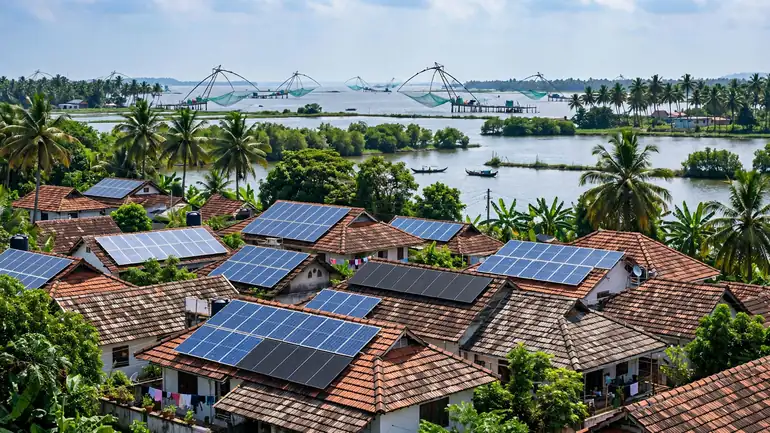
Choosing among Solar Vendors in Kochi is the highest-stakes decision in your rooftop solar journey. Panels and inverters carry standard warranties, but installation quality, honest paperwork and after-sales service vary widely from one installer to the next. A good vendor in Kochi handles everything: a shadow-free roof design, KSEB net-metering approval, subsidy filing on the national portal, and final grid commissioning. A careless one can leave you with a system that underproduces and a subsidy application stuck for months. This guide teaches you how to find and verify registered vendors in Kochi through the official portal, which documents to demand before signing, the red flags that should make you walk away, and the exact subsidy and loan math for homes here in 2026. We name no vendors on this page, because trust should be verified, not advertised.
How to Find Verified Solar Vendors in Kochi
A verified vendor in Kochi is one registered on the national PM Surya Ghar portal (pmsuryaghar.gov.in) and recognised by Kerala State Electricity Board Limited (KSEB). Only installations by such registered vendors, using DCR-compliant equipment, qualify for the central subsidy of up to ₹78,000. Registration matters because the subsidy is released only after the DISCOM inspects and commissions the system, and the DISCOM only commissions work done by vendors it recognises.
Start your search on the portal, not on Google ads. The portal list is the single source of truth for who is allowed to install a subsidised system. When you meet vendors from areas like the busy residential belts of Kochi, ask each one the same set of questions: how many KSEB net-metering applications they filed in the last year, what their average approval time was, and whether they handle the full subsidy filing or expect you to do it. Consistent answers are a good sign; vague answers are not.
Also check how long the company has operated under its current name. A vendor with five years of local installations and a service office in Kochi is far more likely to honour a workmanship warranty than a newly formed team with no local address. Ask for two or three customer references in Kochi whose systems are at least a year old, and actually call them.
Step-by-step: finding vendors on the national portal
- Go to pmsuryaghar.gov.in and register as a residential consumer using your KSEB consumer (service connection) number.
- In the vendor section, filter the installer list by state (Kerala) and then by the Kochi district so you see vendors who actually work in your area.
- Open each shortlisted vendor profile and check the registration status, year of empanelment, and the contact details shown on the portal.
- Cross-check that the vendor is recognised by KSEB (Kerala State Electricity Board Limited), because net-metering approval in Kochi runs through the DISCOM, your local electricity distribution company.
- Invite three or four vendors for a free site survey. Ask each one for a shadow analysis of your roof, not just a price quote.
- Before signing, confirm in writing that the panels are DCR (made with Indian-made solar cells, required for subsidy) and that the vendor will file your net-metering and subsidy paperwork.
Documents and Credentials to Verify Before Signing
A trustworthy installer hands over paperwork without being asked twice. Before you sign anything in Kochi, collect these documents and read them fully.
- DCR declaration for the panels: DCR means Domestic Content Requirement, and it certifies that the solar panels are made with Indian-made solar cells. Only DCR panels qualify for the PM Surya Ghar subsidy. Ask the vendor to name the panel make and model in writing and confirm DCR status.
- MNRE-compliant equipment: modules should come from the ALMM list (the government Approved List of Models and Manufacturers). The inverter should carry standard certifications and a clear 5-year product warranty.
- KSEB empanelment or registration proof: ask for the vendor's registration letter or proof of empanelment with Kerala State Electricity Board Limited. A vendor who cannot show this may still be a good electrician, but your subsidy and net-metering approval will be at risk.
- GST invoice in your name: the invoice must show the system capacity in kW, panel and inverter make and model, and GST separately. You need this invoice for the subsidy claim.
- Warranty cards: typical industry practice is a 25-year panel performance warranty, a 5-year inverter warranty, and a 5-year workmanship warranty covering the installation itself. Get all three in writing, with the vendor's service contact printed on them.
- A written contract: it should state the system size, equipment makes and models, total price, payment schedule linked to milestones (not dates), the installation timeline, and who is responsible for net-metering filing, inspection, and subsidy application.
Keep a single folder, physical or digital, with copies of every document. If a dispute arises later, this folder is your evidence.
Red Flags: When to Walk Away
Good vendors in Kochi are patient with questions. Walk away when you see any of these signs, no matter how attractive the price sounds.
- 100% advance demanded upfront: a standard schedule is 10 to 20% as booking advance, the bulk on material delivery, and the balance after commissioning. Anyone asking for the full amount on day one is a risk.
- Subsidy promised with non-DCR panels: if the quote uses imported (non-DCR) panels but the vendor still promises you the PM Surya Ghar subsidy, the promise is false. Subsidy needs DCR panels, no exceptions.
- No help with net metering: net metering, a two-way meter that credits you for extra power you send to the grid, is essential for savings. A vendor who says "you handle the DISCOM paperwork" is leaving the hardest part to you.
- No written warranty: verbal promises about 25-year panel life mean nothing. Insist on printed warranty cards.
- Pressure tactics: "this price is only valid today" or "subsidy ends this week" are sales tricks. The central subsidy slabs are published and stable.
- A quote far below market: an indicative 3kW rooftop system in 2026 costs roughly ₹1.8 to ₹2.0 lakh before subsidy. A quote of ₹1.2 lakh means corners are being cut, usually in the mounting structure, wiring, or panel quality.
⚠️ Never pay the final instalment before net-meter commissioning
Hold back the last 10 to 15% of the payment until your bi-directional meter is installed and the system is commissioned. This is your only real leverage to make sure the vendor finishes the paperwork, not just the panels.
KSEB Net Metering Process in Kochi
Net metering in Kochi runs through KSEB, the Kerala State Electricity Board Limited: you apply for feasibility, your vendor installs the plant, an Electrical Inspector certifies the installation, and KSEB then fits a bi-directional meter that credits you for surplus power sent to the grid.
KSEB operates its own solar rooftop portal alongside the national PM Surya Ghar portal, so expect to interact with both. Your vendor should submit Annexure-A, the standard KSEB application form for rooftop solar, to your local KSEB section office with your consumer number and proposed capacity.
A Kerala-specific step is certification by the Electrical Inspectorate. The inspector verifies earthing, wiring, and safety clearances before KSEB proceeds to meter installation. Build two to three weeks for this inspection into your project timeline, and make sure your vendor, not you, coordinates the inspector visit.
Kochi’s coastal air is hard on metal, so ask your vendor to specify hot-dip galvanised mounting structures with a written corrosion warranty. A structure that rusts in three years will cost you far more than the small saving on a cheaper one.
Subsidy and Loan Math for Kochi Homes
Under the PM Surya Ghar Muft Bijli Yojana, the central financial assistance (CFA), the government subsidy credited directly to your bank account after commissioning, follows fixed slabs: ₹30,000 for 1 kW, ₹60,000 for 2 kW, and ₹78,000 for 3 kW and above. The money arrives through DBT (Direct Benefit Transfer) after your DISCOM inspects the system and the details are uploaded to the national portal.
Kerala currently has no standing state top-up over the central subsidy, so a Kochi home should plan on the central slabs only: ₹30,000 for 1 kW, ₹60,000 for 2 kW, and ₹78,000 for 3 kW or more. Check the Kerala nodal agency site for any new announcements before you sign, but do not let a vendor add an imaginary top-up to your savings math.
A worked example helps. Take a typical 3 kW system quoted at ₹1.9 lakh before subsidy. With the ₹78,000 central CFA and no state top-up, your net cost lands near ₹1.12 lakh. A 3 kW plant in this region typically generates 12 to 15 units a day, which for most homes wipes out the bulk of the grid bill and pays back the net investment in roughly four to six years.
If you need finance, the national rooftop solar loan programme offers up to ₹2 lakh at around 5.75% per year, with a tenure of up to 10 years and no collateral required for loans up to ₹2 lakh. Apply through the Jan Samarth portal. As an indication, a ₹2 lakh loan at 5.75% over 10 years works out to an EMI of roughly ₹2,200 per month, while a 3kW system in a sunny Kochi home can cut the monthly bill by a similar or larger amount, so the system often pays for itself from month one.
💡 Before you sign: the one-page checklist
Ask every shortlisted vendor in Kochi for the same five things: portal registration proof, DCR declaration naming the panel make and model, a written quote with the KSEB net-metering filing included, warranty cards for panels, inverter and workmanship, and two local customer references. The vendor who answers all five cleanly is usually the right one.
Frequently Asked Questions
How much does a 3kW rooftop solar system cost in Kochi in 2026?
An indicative 3kW system costs roughly ₹1.8 to ₹2.0 lakh before subsidy. With the ₹78,000 central subsidy and no standing Kerala top-up, the net cost lands near ₹1.0 to ₹1.2 lakh. Coastal-grade mounting structures may add a small premium worth paying.
Which DISCOM handles net metering in Kochi?
KSEB, the Kerala State Electricity Board Limited, handles net metering in Kochi. The vendor submits Annexure-A to your local KSEB section office, and KSEB installs the bi-directional meter after the Electrical Inspector certifies the installation.
Why does Kochi need an Electrical Inspector certificate?
Kerala requires the Electrical Inspectorate to verify earthing, wiring, and safety clearances on rooftop solar plants before KSEB commissions them. It is a consumer-protection step, not a hurdle. Your vendor should coordinate the inspection and include it in the project timeline.
Do monsoons make rooftop solar unviable in Kochi?
No. Generation dips during heavy monsoon weeks, but Kerala’s annual sunshine still supports payback in roughly five to seven years for a well-designed 3kW system. Net metering helps because surplus units exported in sunny months offset monsoon-month consumption.
What should coastal homes check in the mounting structure?
Insist on hot-dip galvanised steel structures with a written corrosion warranty. Kochi’s salty air corrodes ordinary mild-steel structures fast. Also confirm stainless-steel fasteners and proper waterproofing where the structure is anchored to the roof.
How do I verify a vendor’s KSEB recognition?
Ask for the vendor’s registration proof and cross-check their recent KSEB net-metering filings by asking for customer references in Kochi with commissioned systems. A vendor active on the national portal with local KSEB experience is what you want.