✓ Verified Expert •
Last Reviewed: October 5, 2026 •
Next Review: April 2027
This guide to Punjab Electricity Tariffs & Solar Payback starts with your current bill. It covers the 2026 slabs set by the PSERC and what each slab means for sizing your system.
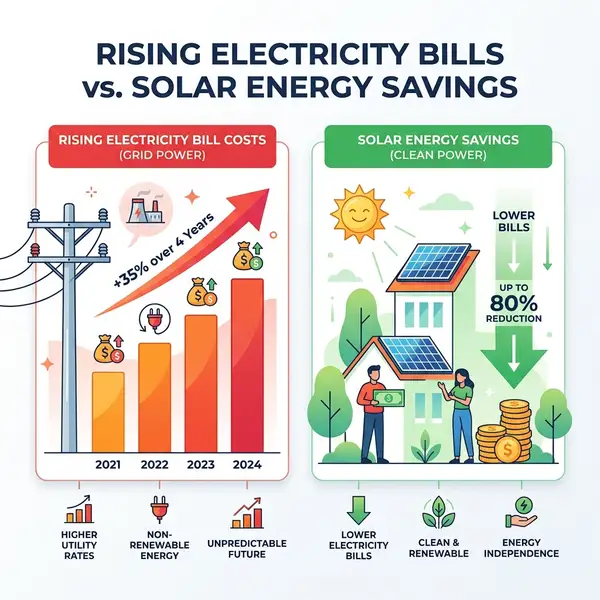
Rising electricity tariffs make solar payback faster.
Punjab electricity tariffs decide your solar payback more than panel prices do. Higher slabs mean faster ROI. Here are the current slabs and what each means for sizing your system.
PSPCL is the primary state-owned DISCOM servicing the vast majority of Punjab (excluding parts of Ludhiana). If your monthly consumption crosses the 300-unit threshold, your effective per-unit cost skyrockets, making you the ideal candidate for the PM Surya Ghar subsidy.
Monthly Consumption
Energy Charge (₹/kWh)
Note
0 - 300 units
Free*
State free-power scheme
Above 300 units
₹7.05
Reduced from ₹7.75
Source: PSERC tariff order FY 2026-27 (effective 1 April 2026). *300 units/month free under the state scheme for households. 13% electricity duty applies on energy charges. Fixed charge ₹130/month.
2. Ludhiana's Single-DISCOM Reality (PSPCL)
Unlike Mumbai, where households choose between competing private distributors, Ludhiana and all of Punjab are served by a single DISCOM: PSPCL. There is no AEML equivalent here and no parallel licensee for residential areas. Your tariff is the PSPCL tariff in section 1, and your net-metering application goes to PSPCL alone.
3. The "Solar Offset" Advantage in Punjab
When you install a PM Surya Ghar subsidised solar plant, you don't just generate electricity; you systematically knock out your most expensive tariff slabs. This is called the tiered offset effect.
Example: the 3kW impact. If your household consumes 600 units a month, the first 300 are free under the state scheme and the remaining 300 are billed at ₹7.05/kWh. A standard 3kW solar system generates approximately 360 units a month. Under net metering, these 360 units are deducted from your gross consumption, bringing your billed consumption down to 240 units, which is fully covered by the free quota. Your solar generation wipes out the entire paid portion of the bill, apart from fixed charges.
4. Time-of-Day (ToD) Tariffs for Commercial Entities
If you are a commercial (LT-II) or industrial (HT-I) consumer in Punjab, PSERC enforces Time-of-Day tariffs. You are charged a premium (up to ₹1.50 extra per unit) during peak morning (0900-1200 hrs) and evening (1800-2200 hrs) slots. Since solar generation peaks precisely during the morning high-tariff window, a captive commercial solar plant serves as an instant hedge against peak ToD penalties.
5. Slab-by-Slab Tariff Analysis & Solar Savings Arbitrage in Punjab
Domestic electricity billing in Punjab is structured on a telescopic tier system under PSERC (Punjab Electricity Regulatory Commission) tariff orders. The more electricity a household consumes, the higher the rate charged per unit on the upper consumption blocks:
Monthly Consumption Tier
Average Effective Rate / Unit
Solar Offset Economics
0 to 150 Units / Month
Baseline subsidized rate (approx. ₹3.00 – ₹4.50)
Modest savings; base meter charges apply.
151 to 300 Units / Month
Standard slab rate (approx. ₹5.00 – ₹7.00)
Solid savings; a 2kW system wipes out this entire bracket.
301 to 500+ Units / Month
High tier slab rate (approx. ₹7.50 – ₹13.00+)
Maximum solar arbitrage! Solar offsets your most expensive top-tier units first, delivering immense financial relief.
Beyond the per-unit energy charges, monthly bills in Punjab carry fixed sanctioned load charges (per kW per month), Fuel Price and Power Purchase Adjustment (FPPCA) surcharges, and state electricity duties. While net metering zeroes out your variable energy consumption charges, you remain responsible for nominal fixed meter charges (typically ₹100 to ₹350 per month depending on sanctioned load).
7. Time-of-Day (ToD) Tariffs & Smart Load Shifting in Punjab
Under new tariff guidelines issued by PSERC, power distribution companies in Punjab are rolling out smart Time-of-Day (ToD) metering for high-consumption residential consumers:
Solar Hours Discount (9:00 AM – 4:00 PM): Electricity drawn from the grid during daytime solar generation hours is billed at a discount of 10% to 20% below standard tariffs.
Peak Evening Surcharge (6:00 PM – 10:00 PM): Heavy power consumed during peak evening grid stress carries a 15% to 25% premium.
How to Maximize Savings: Run heavy power-drawing appliances (water heaters, washing machines, dishwasher, and EV charging) during sunny afternoon hours to run them 100% on self-generated rooftop solar!
8. Net Metering Billing Adjustment & Fixed Meter Fee Transparency
Understanding every line item on your post-solar electricity bill ensures you catch any billing calculation errors early:
Net Energy Units: Stated as Total Import Units minus Total Export Units. When your export units exceed your import units, the energy consumption charge is exactly ₹0.00.
Statutory Fixed Charges: Every residential consumer remains responsible for a nominal fixed meter maintenance charge (typically ₹120 to ₹350 per month based on sanctioned load), even when 100% of power consumed is generated by solar.
 SolarSavings