 SolarSavings

This guide to Tamil Nadu Electricity Tariffs & Solar Payback starts with your current bill. It covers the 2026 slabs set by the TNERC and what each slab means for sizing your system.
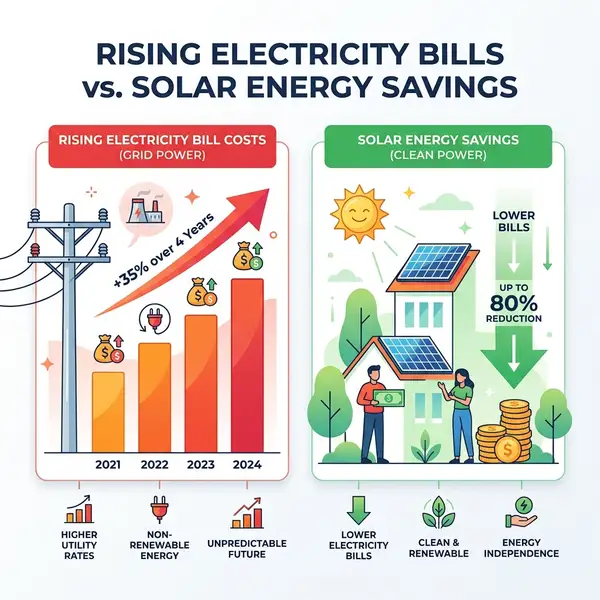
Tamil Nadu electricity tariffs decide your solar payback more than panel prices do. Higher slabs mean faster ROI. Here are the current slabs and what each means for sizing your system.
1. TANGEDCO Residential Tariffs (LT-I): Tamil Nadu Electricity Tariffs & Solar Payback
TANGEDCO is the primary state-owned DISCOM servicing the vast majority of Tamil Nadu (excluding parts of Chennai). If your monthly consumption crosses the 300-unit threshold, your effective per-unit cost skyrockets, making you the ideal candidate for the PM Surya Ghar subsidy.
| Bi-monthly Consumption | Energy Charge (₹/kWh) | Tier |
|---|---|---|
| 1 - 200 units | Free | Tier 1 (up to 500 units) |
| 201 - 400 units | ₹4.70 | Tier 1 (up to 500 units) |
| 401 - 500 units | ₹6.30 | Tier 1 (up to 500 units) |
| 1 - 100 units | Free | Tier 2 (above 500 units) |
| 101 - 400 units | ₹4.70 | Tier 2 (above 500 units) |
| 401 - 500 units | ₹6.30 | Tier 2 (above 500 units) |
| 501 - 600 units | ₹8.40 | Tier 2 (above 500 units) |
| 601 - 800 units | ₹9.45 | Tier 2 (above 500 units) |
| 801 - 1000 units | ₹10.50 | Tier 2 (above 500 units) |
| Above 1000 units | ₹11.55 | Tier 2 (above 500 units) |
Source: TNERC tariff order (TANGEDCO bills bi-monthly, slabs above are per 2-month cycle). Telescopic: crossing 500 units re-prices lower slabs upward, which is exactly why high users save most with solar.
2. Chennai's Single-DISCOM Reality (TANGEDCO)
Unlike Mumbai, where households choose between competing private distributors, Chennai is served by a single DISCOM: TANGEDCO (Tamil Nadu Power Distribution Corporation Ltd). There is no AEML equivalent here and no parallel licensee for residential areas. Your tariff is the TANGEDCO tariff in section 1, and your net-metering application goes to TANGEDCO alone.
3. The "Solar Offset" Advantage in Tamil Nadu
When you install a PM Surya Ghar subsidised solar plant, you don't just generate electricity; you systematically knock out your most expensive tariff slabs. This is called the tiered offset effect.
Example: the 3kW impact. If your household consumes 1,200 units bi-monthly (600/month), you sit in Tier 2 with slabs up to ₹11.55/kWh. A standard 3kW solar system generates approximately 720 units per bi-monthly cycle. Under net metering, these are deducted from your gross consumption, pulling you back under the 500-unit Tier 1 threshold, where the top slab is only ₹6.30/kWh and the free quota rises from 100 to 200 units. Crossing back under 500 units is the single biggest win solar delivers in Tamil Nadu.
4. Time-of-Day (ToD) Tariffs for Commercial Entities
If you are a commercial (LT-II) or industrial (HT-I) consumer in Tamil Nadu, TNERC enforces Time-of-Day tariffs. You are charged a premium (up to ₹1.50 extra per unit) during peak morning (0900-1200 hrs) and evening (1800-2200 hrs) slots. Since solar generation peaks precisely during the morning high-tariff window, a captive commercial solar plant serves as an instant hedge against peak ToD penalties.