 SolarSavings
Did you know that dust, bird droppings, and urban smog make solar maintenance in Rajasthan essential? Generation can drop 15% to 25% in just 4 weeks without cleaning. Keeping your rooftop panels clean and well-maintained is the easiest way to protect your solar investment across Jaipur, Jodhpur, Udaipur, Kota, Ajmer and Bikaner. Here is the practical DIY cleaning guide and preventive maintenance protocol.
1. Why Regular Cleaning Matters in Rajasthan, solar maintenance in Rajasthan
Dust can cut generation 15-25%, so solar maintenance in Rajasthan is not optional in Rajasthan. Here are cleaning schedules, costs and when to call professionals.
- Generation Loss: In urban areas of Rajasthan, air pollution and suspended particulate matter form a sticky microscopic film on panels. Uncleaned panels lose 1.5% to 2.5% of their generating capacity every week during dry spells!
- Hotspot Damage: Bird droppings create a dense localized shadow. Because current continues flowing through the rest of the cell string, the shaded cell acts as a resistor, overheating up to 150°C and causing permanent burn spots (hotspots) that void manufacturer warranties.
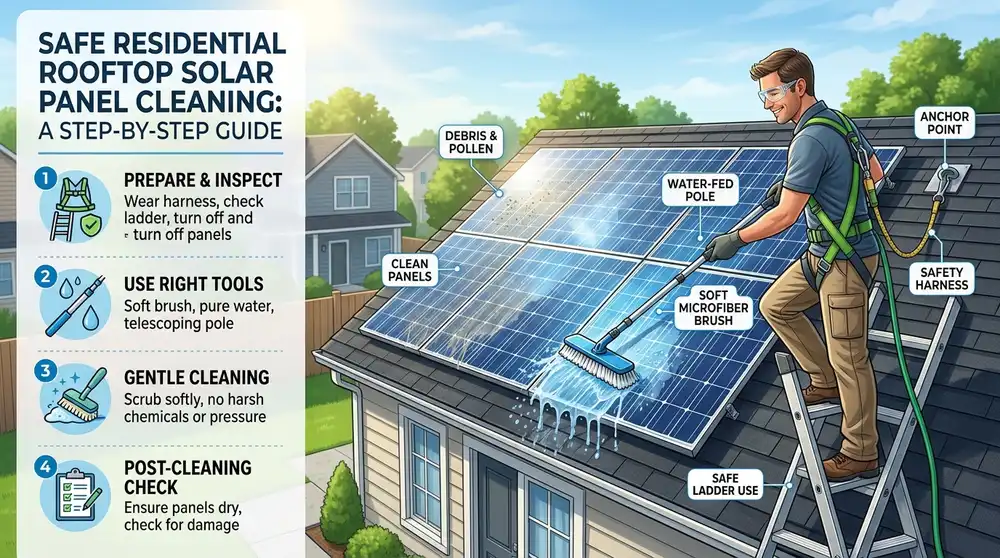
2. The Safe 6-Step DIY Cleaning Protocol
- Clean Only During Early Morning or Late Evening: Never pour cold water on hot solar panels under direct midday sun! The sudden temperature difference (thermal shock) can crack the tempered glass. Clean before 8:00 AM or after 5:30 PM.
- Turn Off the Inverter First: For personal electrical safety, switch off the solar inverter DC isolator switch before using water near panel junctions.
- Use Plain Soft Water: Do not use hard, salty borewell water which leaves white calcium or mineral scale streaks on the glass. Use soft tap water or municipal water.
- Soft Microfiber Brush Only: Never scrub panels with wire brushes, metal scrapers, or harsh abrasive pads. Use a soft telescopic microfiber sponge or water-fed pole.
- No Harsh Chemical Detergents: Avoid laundry detergents, bleach, or acidic cleaning agents which degrade anti-reflective chemical coatings on panel glass. Plain water or a few drops of mild neutral dish soap is all you need.
- Squeegee Dry: Wipe off excess water with a rubber squeegee to prevent water spots.
3. Annual Maintenance Checklist (AMC)
Beyond washing panels every 15 to 20 days, perform this quick 5-minute preventive maintenance check every quarter:
Check the LED status indicator or mobile monitoring app for error codes (e.g., Grid Overvoltage or Insulation Resistance faults).
Ensure all module clamps and anchor foundation bolts remain securely tightened after strong seasonal storm winds.
Check that DC solar cables remain firmly tucked inside UV-resistant PVC conduits and have not been chewed by birds or rodents.
4. Automated Sprinkler Cleaning vs Manual Washing
For roofs that are difficult to access safely, automated sprinkler nozzles can be plumbed directly onto the top edge of each panel frame. Operating on a digital timer connected to your overhead water tank, automated sprinklers rinse panels for 45 seconds at 6:00 AM every two days, consuming less than 15 liters of water while keeping generation consistently at 100% efficiency.
Frequently Asked Questions: Solar Cleaning in Rajasthan
Can I pressure-wash my rooftop solar panels?
No. High-pressure commercial jet washers (above 35–40 PSI) can force water past silicone frame gaskets and cause micro-cracks in the delicate silicon wafers underneath the glass. Always use gentle tap water pressure with a soft microfiber mop.
How frequently should panels be cleaned in urban areas?
In urban belts across Jaipur, Jodhpur, and Udaipur, panels should be cleaned once every 15 to 20 days during dry winter and summer months. During rainy monsoon periods, natural rainfall keeps the glass washed, reducing manual cleaning needs.
Why is borehole groundwater bad for washing panels?
Hard groundwater has high Total Dissolved Solids (TDS), calcium, and magnesium. When the water evaporates in the sun, it leaves a stubborn white calcified crust that permanently blocks sunlight and cannot be removed without abrasive chemicals that void warranties.