✓ Verified Expert •
Last Reviewed: June 25, 2026 •
Next Review: Sept 2026
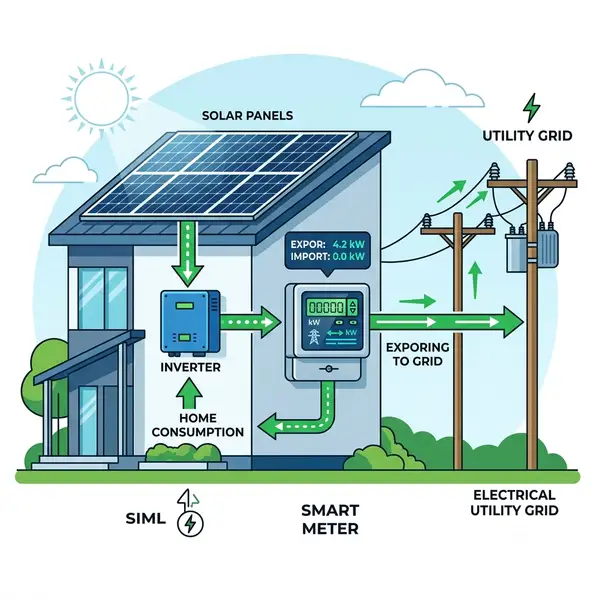
Karnataka BESCOM Solar Net Metering and Gross Metering Settlement Flowchart
Understanding KERC Regulations: Net Metering vs Net Billing (2026)
Karnataka's solar policy has a unique, critical rule based on system size that every homeowner must understand before purchasing a system. The KERC (Karnataka Electricity Regulatory Commission) strictly divides systems into two categories.
📋 Systems Up To 10 kW (True Net Metering)
If your system is 1kW to 10kW, you fall under a 1:1 Net Metering framework. You export surplus power to the grid during the day and import at night. At the end of the month, your exported units are subtracted 1:1 from your imported units. You only pay for the net difference. This is highly favorable.
Systems Above 10 kW (Net Billing / Gross Metering)
If your system is above 10kW (e.g., 12kW), you fall under the Net Billing mechanism.
Under Net Billing, you do not get a 1:1 unit offset.
Instead, all energy you export to the grid is monetized at a lower rate fixed by KERC (e.g., ₹2.84 per unit).
Meanwhile, all energy you import is billed at your standard high tariff slab (e.g., ₹8.50 per unit).
Strategic Takeaway: If you are a residential consumer, it is financially optimal to keep your system size at or below 10kW to retain the 1:1 Net Metering benefits.
Sanctioned Load & Transformer Limits
BESCOM and other Karnataka DISCOMs enforce these capacity limits:
Sanctioned Load: You can install a solar plant up to 100% of your sanctioned connected load.
Transformer Capacity: The combined capacity of all solar installations in your area cannot exceed 80% of the local distribution transformer's capacity. In dense areas of Bangalore, this limit is sometimes hit, resulting in feasibility rejections.
Your Solar Journey Continues
Keep reading the Karnataka cluster to ensure a successful rooftop installation:
Official 2026 Consumer Rights & DISCOM Escalation Protocol in Karnataka
Under the latest regulations notified by the Karnataka Electricity Regulatory Commission (KERC) and MNRE guidelines, consumers across Bengaluru, Mysuru, Mangaluru, Hubli-Dharwad, Belagavi, and Shivamogga are legally protected by strict Service Level Agreements (SLAs). If your rooftop solar net meter installation, feasibility inspection, or subsidy disbursement is delayed, follow this formal escalation hierarchy:
Submit written grievance ticket regarding net meter testing or portal document hold.
Level 2: Circle Superintending Engineer
Executive Engineer (Solar Renewable Cell)
7 Working Days
Formal grievance filing on DISCOM portal with application acknowledgement number.
Level 3: Regulatory Ombudsman
Consumer Grievance Redressal Forum (CGRF) under Karnataka Electricity Regulatory Commission (KERC)
15 Working Days
Binding legal hearing. Utility can be fined daily penalties for willful commissioning delays.
Mandatory Inspection Documents Checklist
When the DISCOM inspection team visits your premises for the final bi-directional meter synchronization, have these exact physical documents signed and organized in a physical file:
Joint Inspection Report (JIR): Signed by the homeowner and the empanelled solar engineer.
Factory Flash Test Report: Showing peak watt test results matching your panel serial numbers.
DCR Undertaking Stamp Paper: Affirming domestic solar cell content as mandated by MNRE.
Inverter Type Test Certificate: Confirming anti-islanding compliance (IS 16221 / IS 16169).
💡 Consumer Tip: Always keep a timestamped digital copy of your Work Completion Report (WCR) and joint inspection form. If your net meter is not installed within 15 days of successful plant inspection, your vendor can register a formal complaint on the PM Surya Ghar National Grievance Portal.
5. In-Depth Energy Banking & Settlement Regulations in Karnataka
Net metering rules in Karnataka are established by KERC (Karnataka Electricity Regulatory Commission). The fundamental principle is that the power grid functions as an infinite, 100% efficient virtual battery for your rooftop system:
1:1 Energy Offset: Every kilowatt-hour (unit) you push into the grid during daytime hours offsets exactly one unit consumed from the grid during nighttime on a 1:1 basis, saving electricity at your highest retail tariff slab.
Settlement Cycle: Surplus banked units roll over month to month throughout the financial year (April 1 to March 31). In months with heavy air conditioning use, you automatically draw upon credits accumulated during mild spring months.
Annual Buyback Settlement: On March 31, if you still have remaining surplus units in your credit account, your DISCOM (BESCOM, MESCOM, HESCOM, CHESCOM, and GESCOM) settles and buys out the remaining units at predetermined regulatory rates (typically ₹2.00 to ₹3.00 per unit).
Net Meter Register
Direction of Electricity
Billing Formula
Import Register (kWh)
Power drawn from grid at night or rainy days
Total units consumed from utility
Export Register (kWh)
Surplus solar power sent into neighborhood grid
Total clean units exported
Net Billed Energy Units
Billed amount = (Import Units - Export Units)
If Export > Import, Energy Charge = ₹0 + Surplus Units Banked!
7. Net Metering vs. Gross Metering: What Consumers in Karnataka Must Know
Understanding the fundamental billing difference between net and gross metering protects you from unfavorable contract terms:
Net Metering (Residential Homes up to 10kW): You save electricity at your full retail tariff rate (undefined). Units exported cancel out units imported 1:1, delivering the fastest 3-year payback.
Gross Metering / Net Billing (>10kW or Commercial): All solar generation is exported to the grid at a pre-fixed feed-in rate (typically ₹2.50 to ₹3.00/unit), while power consumed is purchased at full commercial tariff rates. This model extends the payback period to 5-6 years.
 SolarSavings