✓ Verified Expert •
Last Reviewed: June 25, 2026 •
Next Review: Sept 2026
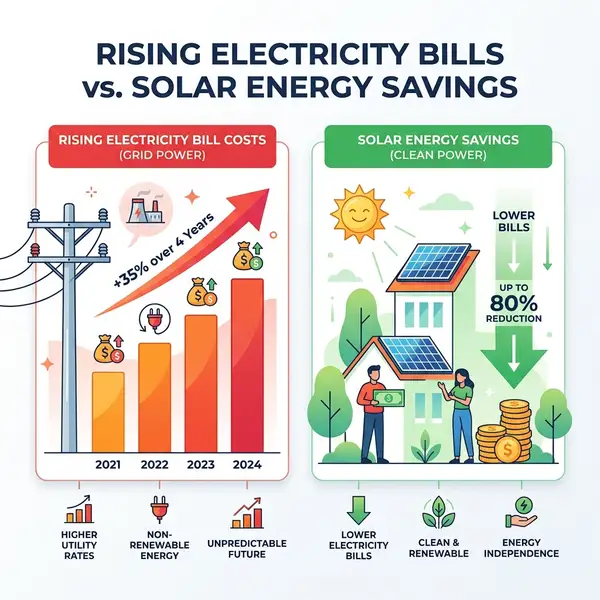
Delhi Electricity Regulatory Commission (DERC) slab tariff inflation and solar savings chart
Delhi DISCOM Tariffs & Ultimate Payback Analysis
Delhi's electricity pricing is unique due to the Delhi Government's free electricity subsidy for consumers under 200 units. However, if your consumption exceeds 400 units, the rates spike, making solar highly profitable.
Standard Residential Slabs (Excluding Free Subsidies)
Monthly Consumption Slabs
Energy Charge (₹/Unit)
Effective Rate (incl. PPAC & Surcharges)
0 - 200 Units
₹3.00
Free (if eligible for state subsidy)
201 - 400 Units
₹4.50
~ ₹6.50 / Unit
401 - 800 Units
₹6.50
~ ₹9.00 / Unit
Above 800 Units
₹7.00
~ ₹10.00 / Unit
The "Double-Dip" Payback Calculation
If your household consumes 500 units a month, your blended effective rate is approximately ₹8.50 per unit, resulting in a monthly bill of around ₹4,250.
By installing a 4 kW solar system:
- Net Upfront Cost: ~₹1,20,000 (after ₹78,000 PM Surya Ghar subsidy).
- Grid Savings: Offset 480 units/month = ₹4,080 saved monthly (₹48,960 annually).
- GBI Earnings: 480 units generated × ₹2.00/unit = ₹960 earned monthly (₹11,520 annually).
- Total Annual Value: ₹48,960 + ₹11,520 = ₹60,480.
- Payback Period: ₹1,20,000 / ₹60,480 = Under 2 Years!
The combination of high-slab avoidance and the direct GBI cash infusion makes Delhi the most lucrative city in India for rooftop solar adoption.
Your Solar Journey Continues
Keep reading the Delhi cluster to ensure a successful rooftop installation:
Official 2026 Consumer Rights & DISCOM Escalation Protocol in Delhi
Under the latest regulations notified by the Delhi Electricity Regulatory Commission (DERC) and MNRE guidelines, consumers across South Delhi, Dwarka, Rohini, Pitampura, Laxmi Nagar, Janakpuri, and Vasant Kunj are legally protected by strict Service Level Agreements (SLAs). If your rooftop solar net meter installation, feasibility inspection, or subsidy disbursement is delayed, follow this formal escalation hierarchy:
Escalation Level
Designated Authority
Mandated SLA Timeline
Action & Remedy
Level 1: Local Sub-Division
Assistant Engineer / Junior Engineer (BSES Rajdhani (BRPL), BSES Yamuna (BYPL), and Tata Power DDL (TPDDL))
3 Working Days
Submit written grievance ticket regarding net meter testing or portal document hold.
Level 2: Circle Superintending Engineer
Executive Engineer (Solar Renewable Cell)
7 Working Days
Formal grievance filing on DISCOM portal with application acknowledgement number.
Level 3: Regulatory Ombudsman
Consumer Grievance Redressal Forum (CGRF) under Delhi Electricity Regulatory Commission (DERC)
15 Working Days
Binding legal hearing. Utility can be fined daily penalties for willful commissioning delays.
Mandatory Inspection Documents Checklist
When the DISCOM inspection team visits your premises for the final bi-directional meter synchronization, have these exact physical documents signed and organized in a physical file:
Joint Inspection Report (JIR): Signed by the homeowner and the empanelled solar engineer.
Factory Flash Test Report: Showing peak watt test results matching your panel serial numbers.
DCR Undertaking Stamp Paper: Affirming domestic solar cell content as mandated by MNRE.
Inverter Type Test Certificate: Confirming anti-islanding compliance (IS 16221 / IS 16169).
💡 Consumer Tip: Always keep a timestamped digital copy of your Work Completion Report (WCR) and joint inspection form. If your net meter is not installed within 15 days of successful plant inspection, your vendor can register a formal complaint on the PM Surya Ghar National Grievance Portal.
5. Slab-by-Slab Tariff Analysis & Solar Savings Arbitrage in Delhi
Domestic electricity billing in Delhi is structured on a telescopic tier system under DERC (Delhi Electricity Regulatory Commission) tariff orders. The more electricity a household consumes, the higher the rate charged per unit on the upper consumption blocks:
Monthly Consumption Tier
Average Effective Rate / Unit
Solar Offset Economics
0 to 150 Units / Month
Baseline subsidized rate (approx. ₹3.00 – ₹4.50)
Modest savings; base meter charges apply.
151 to 300 Units / Month
Standard slab rate (approx. ₹5.00 – ₹7.00)
Solid savings; a 2kW system wipes out this entire bracket.
301 to 500+ Units / Month
High tier slab rate (approx. ₹7.50 – ₹13.00+)
Maximum solar arbitrage! Solar offsets your most expensive top-tier units first, delivering immense financial relief.
Beyond the per-unit energy charges, monthly bills in Delhi carry fixed sanctioned load charges (per kW per month), Fuel Price and Power Purchase Adjustment (FPPCA) surcharges, and state electricity duties. While net metering zeroes out your variable energy consumption charges, you remain responsible for nominal fixed meter charges (typically ₹100 to ₹350 per month depending on sanctioned load).
7. Time-of-Day (ToD) Tariffs & Smart Load Shifting in Delhi
Under new tariff guidelines issued by DERC, power distribution companies in Delhi are rolling out smart Time-of-Day (ToD) metering for high-consumption residential consumers:
Solar Hours Discount (9:00 AM – 4:00 PM): Electricity drawn from the grid during daytime solar generation hours is billed at a discount of 10% to 20% below standard tariffs.
Peak Evening Surcharge (6:00 PM – 10:00 PM): Heavy power consumed during peak evening grid stress carries a 15% to 25% premium.
How to Maximize Savings: Run heavy power-drawing appliances (water heaters, washing machines, dishwasher, and EV charging) during sunny afternoon hours to run them 100% on self-generated rooftop solar!
8. Net Metering Billing Adjustment & Fixed Meter Fee Transparency
Understanding every line item on your post-solar electricity bill ensures you catch any billing calculation errors early:
Net Energy Units: Stated as Total Import Units minus Total Export Units. When your export units exceed your import units, the energy consumption charge is exactly ₹0.00.
Statutory Fixed Charges: Every residential consumer remains responsible for a nominal fixed meter maintenance charge (typically ₹120 to ₹350 per month based on sanctioned load), even when 100% of power consumed is generated by solar.
 SolarSavings